On a larger scale, Ramelius contribute to a sustainable economy that is strong and resilient, environmentally conscious and creates value for communities. Without strong economic performance, Ramelius would limit its capacity to provide jobs for local workforces, generate tax revenue to fund public services or support supplier businesses. The Company’s strategy aims to promote a sustainable economy that fosters economic development, local prosperity through goods and services, and through engagements within regions to generate jobs.
In terms of local workforce, Ramelius are transparent about its preference for local hiring, by encouraging local residents who reside within a reasonable drive-in / drive-out distance from our operating sites to apply for vacancies.
Ramelius acknowledges the range of governance, social and environmental responsibilities to which it must adhere to ensure its business meets community and government expectations.
The Board is responsible for overseeing the activities of the Company and monitoring compliance with legal and other regulatory requirements, including accounting standards, continuous disclosure and ASX Listing Rules. The Managing Director is responsible for developing and implementing internal control and regulatory compliance policies and procedures.
Some of the key regulatory bodies and frameworks Ramelius report under include:
- National Greenhouse and Energy Reporting (NGER)
The national framework for reporting and disseminating Company information about greenhouse gas emissions, energy production and energy consumption. - National Pollutant Inventory (NPI)
Provides the community, industry and government with information about substance emissions in Australia. - Workplace Gender Equality Agency (WGEA)
An Australian Government statutory agency charged with promoting and improving gender equality in Australian workplaces. - Australian Attorney General (Modern Slavery Act 2018 (CTH))
Requires certain large businesses and other entities in Australia to make annual public reports on their actions to address modern slavery risks in their operations and supply chains.
All Ramelius employees, including independent contractors who operate for or on behalf of Ramelius, are expected to uphold the standards outlined in the Code of Conduct Policy. As a condition of their engagement, this mandates that all employees and contractors uphold suitable standards of conduct, ethics, and integrity.
Code of Conduct Policy Expectations:
- Honesty and fairness in all dealings with stakeholders, co-workers, management, and the public;
- Respect for our equipment, supplies and property;
- Zero tolerance for discrimination, harassment, or offensive language and/or behaviour in the workplace;
- Adherence to appropriate Professional Codes of Practice and/or ethics; and
- Zero tolerance for postings on any social media platform material that could reasonably be deemed inappropriate or unlawful.
The Anti-Bribery and Corruption Policy ensures that all employees behave honestly and follow the laws and ethical standards of the Company across all operations. Conduct that is unethical, dishonest, or corrupt is not permitted. To prevent, detect, and respond to acts that involve or could entail unethical practices such as bribery and/or corruption, Ramelius is committed to mitigating risks and maintaining controls. Employees of Ramelius who are discovered to have committed an act of corruption or bribery shall face disciplinary action. The policy also ensures that Ramelius only conduct business with those who also engage in ethical and lawful practices.
The Voluntary Principles on Security and Human Rights (VPSHR) and the UN Guiding Principles on Business and Human Rights serve as guiding principles in ensuring that everyone has access to their basic freedoms and human rights. The Ramelius Modern Slavery and Human Rights Policy supports this commitment.
Due diligence in respect to human rights is carried out to guarantee Ramelius continues to monitor the effectiveness of its Modern Slavery and Human Rights Policy. Each year, the Company issues its Modern Slavery Statement, which details the risks of modern slavery in operations and supply networks, as well as the steps needed to take to address these risks.
Forced work, human trafficking, child labour, and discrimination are some of the potential human rights risks that are examined during the Company’s due diligence procedure. Ramelius continue to review both existing and new activities to identify, prevent, and manage risks associated with modern slavery and human rights.
Whistleblowing
To enable all directors, employees, potential employees, contractors, consultants, and external stakeholders to anonymously raise concerns, Ramelius has engaged an external whistleblower platform.
Company-wide training on the Company’s Whistleblower Policy and procedures is in place. The training strives to ensure that every employee is aware of the Whistleblower Policy and knows how to report any improper, unethical, or unlawful behaviour. This is in accordance with the extended legal rights and protections for whistleblowers provided by the Corporations Act 2001 (Cth).
Ramelius’ Incident Reporting and Investigation Procedure outlines the process involved in incident reporting and the investigation requirements for all incidents for Ramelius and its subsidiaries. This procedure aims to ensure all actions from incident reporting and investigations are captured and managed. This procedure is based on legislative, company and site requirements.
Risk management at Ramelius is overseen by the Board. All Board members are highly experienced in the oversight, management and mitigation of critical business risks. The Board, Audit and Risk & Sustainability Committees, and Executive Team regularly review the risk portfolio of the business and the effective management of risks.
The Ramelius risk and control framework, Ramelius Essentials, empowers its people to perform by ensuring that the Company does the fundamental things well. The Essentials Working Group (EWG) meets regularly, with risk management a standing agenda item. The Essentials Program focuses on integrating its approach to managing the fundamental requirements of the business which are to:
- Maintain and apply good standard practices for controlling activities;
- Understand and effectively manage key risks across the business;
- Learn, share, and take action from these learnings;
- Comply with the requirements of laws impacting the business;
- Maintain a safe system of work;
- Operate in accordance with industry sustainability principles;
- Remain resilient in the face of adverse and extreme events; and
- Constantly monitor and review activities and performance.
Risk registers are held for each Ramelius site as well as the corporate office and are managed by the respective work group, with oversight provided by HSE Managers. A risk manager’s responsibility is to coordinate the development and maintenance of registers of material risks and opportunities. They must monitor and control improvement activities, as well as report to key stakeholders on material risks. Each risk register is formally reviewed and updated at least annually and is used in the budget planning process to prioritise expenditure in an effort to mitigate risk. Climate-related risks and relevant ESG risks and opportunities are also incorporated into the sustainability risk register.
The Lessons Learned Procedure helps Ramelius maintain compliance and adequate management of risks. Lessons Learned is simply knowledge and insight gained through experience, which when shared, improves corporate, project and operational capabilities and practices. To capture and communicate knowledge from lessons, a formal process is applied to identify and analyse positive and negative outcomes from an experience. This includes capturing what was done well or gaps, so that the Company can reduce the risk of repeating mistakes and increase its ability to repeat successes. An experience that is subject to lessons learned might be:
- A project delivered;
- An activity or task the Company was involved in; and
- An incident that occurred or a near miss.
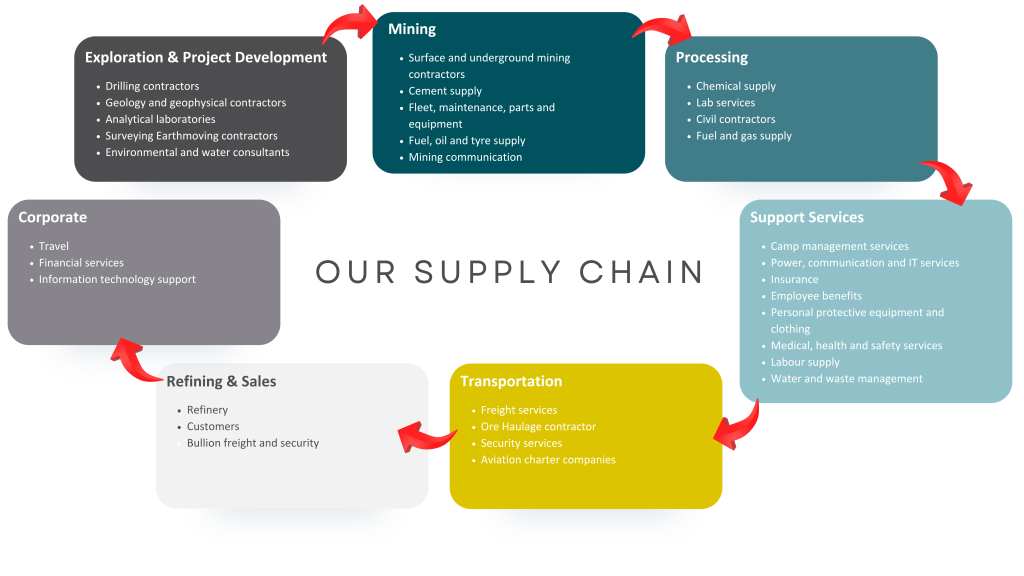
Contractors and suppliers are a critical part of the Ramelius business and are relied upon to ensure that it can deliver on its strategy. Ramelius strives to support local suppliers where possible, and source goods and services from businesses in the communities in which it operates. This preference for local suppliers is embedded in the formal Purchase Order Standard Terms and Conditions.
Ramelius requires its suppliers to act in an ethical and responsible manner as a condition of conducting business together. This is enforced via the Company’s Purchase Order Standard Terms and Conditions and its Supplier Code of Conduct Standard which set out the minimum requirements expected from its suppliers. These conditions are also included in its contractual arrangements. Ramelius’ standard supplier contracts contain anti-corruption and modern slavery clauses, which require suppliers not to engage in conduct inconsistent with Australian and international laws and standards.
Ramelius assesses the potential for modern slavery risks within its supply chain by engaging with suppliers during the screening process. This formal and informal contact, which includes the completion of a specific modern slavery risk questionnaire by suppliers, allows the Company to consider all aspects of a supplier’s business and to identify matters that may need further attention or remediation. The questionnaire is designed to:
- Enable suppliers to assess and address modern slavery risks as required under the Modern Slavery Act;
- Support the identification of modern slavery risks;
- Foster collaborative efforts to address these risks;
- Improve transparency; and
- Identify areas for further due diligence.
The potential for modern slavery at Ramelius is considered low as its offices, operations, and suppliers are predominantly Australian-based and therefore subject to a strong regulatory environment.
The most relevant risk areas within its supply chains with potential for modern slavery practices to exist are First Nations Peoples and remote communities in which the Company operates, procurement of certain goods and services (part of which may be sourced overseas), and labour conditions. All personnel, whether Ramelius or contractor-engaged, are subject to Australian employment law and undertake various induction, other training, and qualification programs. Ramelius are also guided by the UN Guiding Principles on Business and Human Rights.
Information technology (IT) and cybersecurity are viewed as significant risks for Ramelius. Ramelius prioritises the protection of the confidentiality, integrity and availability of business information and the systems and equipment on which information is stored. Ramelius holds responsibility to manage increasing external threats to information integrity and the risk of internal release or misuse, either deliberate or accidental. These commitments are outlined within the Ramelius Information Security Policy. IT security matters are overseen by the Board and Audit Committee.
Cybersecurity incidents occur when there is a breach that requires corrective action because it threatens the confidentiality, availability and integrity of an information system or the information a system processes, stores or transmits. To support mitigation efforts, Ramelius has a series of measures and procedures that will protect the organisation from cyber-attacks and IT system interruptions. This includes the IT Cyber Security Response Procedure.
The IT Cyber Security Response Procedure serves to:
- Identify the systems and procedures in place to minimise the likelihood of a cybersecurity incident;
- Define the processes required to ensure an organised approach to managing cybersecurity incidents within Ramelius; and
- Coordinate responses and resolution efforts to prevent or limit subsequent damage.
Ramelius currently utilise platforms to protect data, information, and technology assets from sophisticated attackers by detecting, investigating, and responding to cybersecurity threats in real-time. Ramelius also conducts a number of initiatives to prevent incidents from occurring. These include:
- Mandatory training to educate employees on cybersecurity best practices and the identification of potential threats;
- Use of an external cybersecurity incident response team to be available to react 24/7 to any cybersecurity incidents;
- Penetration testing conducted four times a year (three by external providers, and one internally);
- Monitoring external threat detection and intrusion detection systems; and
- External verification and vulnerability analysis.
Innovation is an important component of the Ramelius business and a driver for resource efficiency, productivity improvement and competitive advantage.
Ramelius recognises the importance of strategic engagements to generate innovative ways to capture economic, environmental and social value and is committed to collaborative research and development.
 Ramelius continues to support innovative research into mineral exploration being undertaken by Australia’s national science agency the Commonwealth Scientific and Industrial Research Organisation (CSIRO). More information on collaboration with the CSIRO can be found within the Company’s annual Sustainability Reports.